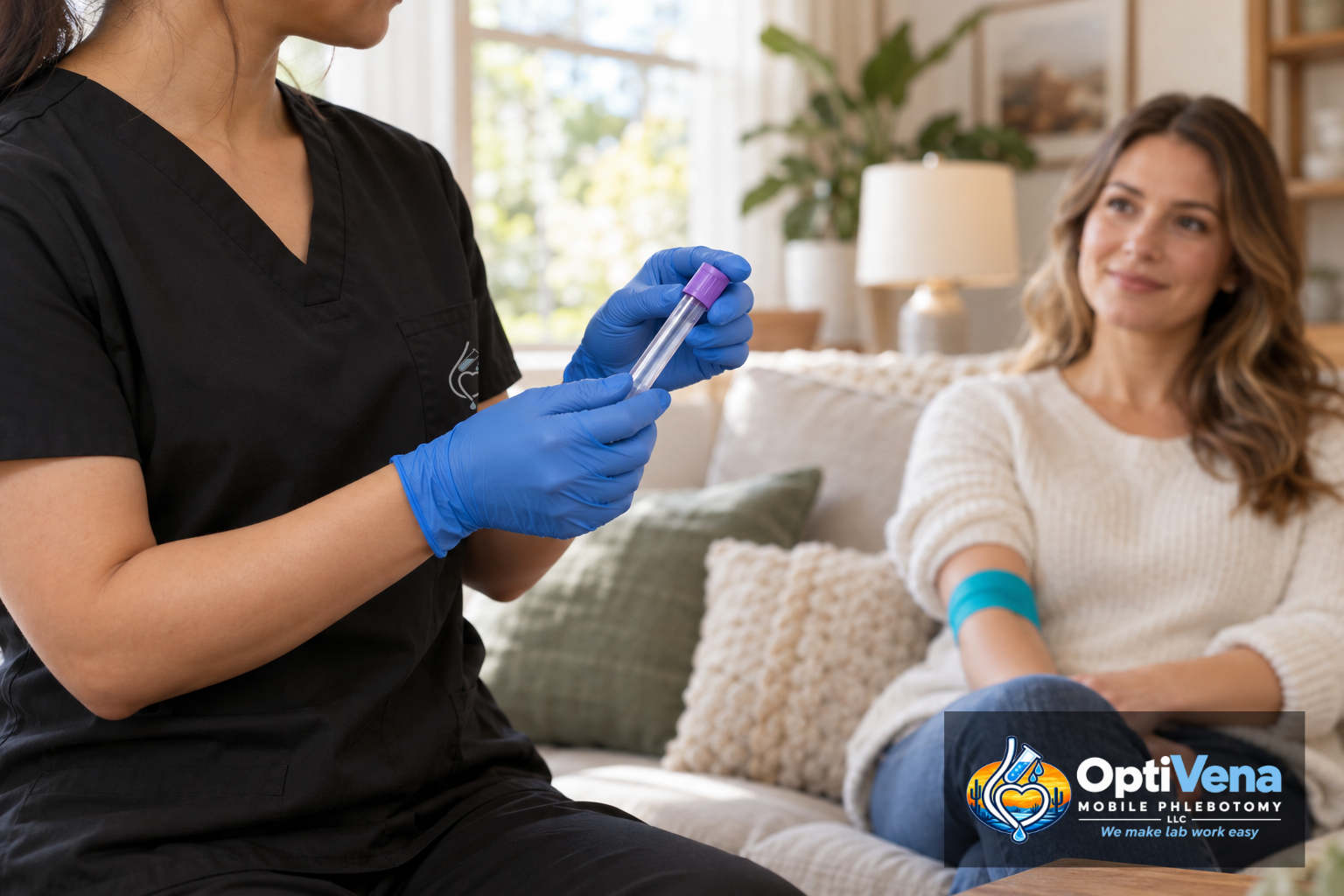
What to Expect During Your First At-Home Blood Draw

If you have never had blood drawn outside of a lab or clinic, it is normal to have questions. Who shows up. What they bring. Whether it feels different than sitting in a patient service center chair. Most of the uncertainty around an at-home blood draw comes down to simply not knowing the sequence of events, so here is exactly what happens from booking to results, start to finish.
Before You Book
Most routine blood work requires a lab order from your provider. If your doctor already sent one to a lab like Labcorp or Sonora Quest, you can typically redirect that same order to a mobile service instead of visiting the lab in person. If you are ordering your own wellness panel without a doctor's visit, that is usually an option as well, depending on the test.
Once you have an order in hand, booking takes a few minutes online or by phone. You will choose a date, a time window, and confirm the location, whether that is your home, your office, or another comfortable spot.
The Day Before
There is nothing special you need to do to prepare your home. No cleaning for a home health worker, no special setup. If your test requires fasting, your lab order will say so, and the instructions are the same as they would be for an in-person visit: typically nothing but water for eight to twelve hours beforehand. Staying hydrated the day before also tends to make the draw itself go more smoothly, since well-hydrated veins are easier to access.
When the Phlebotomist Arrives
Your phlebotomist arrives within the scheduled window, carrying everything needed for the visit: collection tubes, needles, alcohol swabs, bandages, and a cooler or specimen bag for proper handling afterward. They will confirm your identity and review the lab order together with you, the same verification step you would go through at any clinic.
You pick where you sit. A kitchen table, a couch, a home office chair. Anywhere with good light and a stable surface for your arm works. There is no exam table and no clipboard of forms to fill out in a waiting room, because that part has already been handled during booking.
The Draw Itself
The actual collection takes just a few minutes. Your phlebotomist will apply a tourniquet, locate a vein, clean the site, and perform the draw. If your veins are usually hard to find, here is what helps. If your test requires multiple tubes, they will be filled in the correct order to preserve accuracy, exactly as a lab would do it. Afterward, a small coban wrap goes over the site to help with clotting, and you are free to remove it after fifteen to twenty minutes.
Most people say the experience feels calmer than a clinic draw, simply because there is no waiting room noise, no rushed feeling, and no line of other patients behind you. If you tend to feel lightheaded during blood draws, being able to lie back on your own couch afterward, rather than walking straight back out to a parking lot, makes a real difference.
After the Draw
Once the collection is complete, your phlebotomist processes the specimen according to the lab's requirements. Some tests need to be spun in a centrifuge or kept refrigerated or frozen; others simply need to reach the lab within a certain window. Handling is one of the reasons a lab can reject a sample and ask for a redraw, and we break down why labs ask for a redraw and how a visit at home lowers the odds.. Either way, this part happens on-site or immediately after, so nothing is left to chance between your kitchen table and the lab.
Your samples are delivered to the lab your provider works with, the same lab that would have processed them if you had gone in person. Results are sent to your ordering provider through their normal channel, so nothing about how you receive or discuss your results changes.
If Your Appointment Isn't a Routine Draw
Everything above describes a standard routine blood draw. If you're booking for therapeutic phlebotomy or a specialty mail-in kit, a few steps look different. Therapeutic phlebotomy appointments run longer, typically 30 to 45 minutes, and include a check of your vitals and hemoglobin or hematocrit levels before the draw begins, along with a short observation period afterward before your phlebotomist leaves. Specialty kits, like IGeneX or Galleri, often require on-site processing such as centrifuging or refrigerated handling, plus proper packaging for shipment, all of which your phlebotomist handles as part of the visit. If either of these applies to you, it's worth reading through the appointment details on the therapeutic phlebotomy or specialty kit pages beforehand so you know what to expect.
What Is Different, and What Is Not
The parts that matter for accuracy, the collection technique, the tube order, the specimen handling, are identical to an in-person draw. What changes is everything around it: no drive, no waiting room, no rearranging your morning to make an 8 a.m. lab slot before work. For a first-timer, that is usually the biggest surprise. It is not a simplified version of a blood draw. It is the same blood draw, just relocated to wherever you already are.
If you have been putting off routine labs because the logistics of a lab visit feel like more trouble than they are worth, knowing what the appointment actually looks like tends to remove most of the hesitation. Book your first at-home blood draw with OptiVena and see the process for yourself.